Showing posts with label DC comics. Show all posts

Wednesday, February 16, 2011

Motivation is the key...

Another comic post, but this time in a more serious vein (serious comics?). The motivation for any hero to take up the mantle or cause is fairly straight forward and easy to understand; they want to do good for humanity by using their skills to make the world a better place. But today, we're going to go over the motivation behind two specific events from two comic universes (universi?) and compare the effects of these events on the heroes in question. First, we'll analyze Iron Man's motivation behind his decision in the 'Civil War' arc, then take a look at a moment from 'Superman: Grounded' and compare their effectiveness, appropriateness, and believability...

Roughly 4 years ago, Marvel Comics released a huge crossover event called 'Civil War' (one in a loooooooong string of huge crossovers...). In a nutshell, a reckless tragedy involving a team of lesser known heroes way out of their league, destroyed a small town and killed hundred (all caught on TV, I might add...); calling into question how should superheroes be regulated. This split the hero community between those believing that being registered and regulated by the government for accountability's sake vs. those who believe that heroes should act outside the law since those who were sanctioned could be pointed at targets regardless of right and wrong. The heads of each faction were Captain America, leading the said against regulation, and Iron Man, who leads the registered heroes side of the fence. Iron Man took up the side of regulation when one of the victim's mothers assaulted him emotionally at her son's funeral. She screamed at him that his flagrant attitude towards the law and society over the years inspired a younger generation and precipitated the actions that killed her son. This struck a chord with the armored billionaire and pushed hard for the regulation of the hero community. This inevitably lead to a showdown between the two factions (as well as their leaders...), ending in the surrender, capture and eventual assassination of Captain America...

Now, let's jump to today, but switch universes: after an event which caused the destruction of the New Kryptonians in DC comics (look it up; it's too much to go into here...), Superman was feeling disconnected to the people of Earth. More specifically, he felt removed from the people of America, to whom he had sworn to protect (Truth, Justice, and the American Way and all...). To this end, The Man of Steel set off on a walk (see why it's called 'Grounded'...) across America to help the average person with their daily lives and attempt to reconnect to the everyday, average American (good luck, big guy...). He makes stops at various cities and makes a show trying to connect and going through some self-doubt to show how he is growing as a person and rediscovering what it means to be human. The series is still ongoing, so there is no wrap up yet like with 'Civil War', but the moment in question involves a press conference Superman gives and a grieving woman comes up to him and slaps him (smooth...). She tells him how the love of her life had an inoperable brain tumor and she knew Superman could fix it. But when she tried to contact him (I'd love to know more about that...), all she was told is that he was 'prevent[ing] some big interstellar crisis' (is that all...) and that Superman was 'doing something important'. Her husband died and she blamed The Man of Tomorrow as he could have used his super abilities to save her husband. This moment further spurred Superman to take his journey across the country...

How do these moments stack up to each other? Both speak to how the populace of each universe view and regard their hero population and it is for this reason the 'Civil War' moment is more poignant that the one from 'Superman: Grounded'. In Marvel, the public are not always on the side of the hero and often regard superheroes as much in fear as in adulation (look at what Wolverine, the Punisher, and Hulk do on a regular basis and tell me I'm wrong...). So a public outcry over the reckless nature of young heroes in the Marvel universe is to be expected if not a complete given. By having the mother assault Tony Stark and make him realize that his hedonistic nature contributed to the idea that anyone with powers could do whatever they please, it speaks to the maturity and evolution of the character of Iron Man and that he is willing to become the role model and take responsibility for his actions (Uncle Ben would be so proud...). In a different time, Iron Man and Cap would have been on opposite sides, but having the split this way and forcing Tony to choose between his brothers-in-arms and what is good for the people of America is good story telling and good character development...

In contrast, the moment in 'Superman: Grounded' does not work for me as motivation for Superman to try and reconnect with the Untermensch (if you get it, you get it...). The idea of Superman has been built upon that most view him as a god and that he is a well respected and well loved member of society. This also leads to the fact that the people of DC's Earth lean on their heroes more than Marvel's seem to. When you have protectors such as Green Lantern, Superman, and Wonder Woman around, life can go on a bit more recklessly than it might otherwise if such demigods didn't exist. Also, the responsibility of the safety of man, accidental or otherwise, is now placed on super beings able to do the impossible at the drop of a hat. This moment is the case and point of the attitude towards supers in DC comics. Granted, we are supposed to feel bad for this widow, but to have her displace the blame onto Superman (he was battling Kryptonians in space to save Earth, for God's sake...) is a bunch of weak sauce. Superman, as close to a deity as he might be, cannot be everywhere at once and it is childish, even in the face of the death of a loved one, to blame him for something that is small potatoes in comparison to Earth's safety...

What it comes down to is cause in the end. Iron Man's actions (as well as many Marvel heroes...) as a super hero can be traced as the inspiration for the actions of later generations of heroes. His recklessness and lack of responsibility for his actions is transferable to the next generation. It makes sense for him to be personally affected by the tragedy when put into context by a grieving mother. However, Superman did not cause the husband's tumor, much like he did not cause an inescapable flood or a terrorist bombing. Does he have the abilities to stop said catastrophe? Absolutely. Does that automatically make him available to handle every potentially tragic event that may, and probably will, occur in life? Hell to the no. Superman's sin is being gifted with these powers and having a populace that unfairly treats him like a miracle on a stick. I feel sorry for the Big Blue Boy Scout...

Tuesday, February 8, 2011

If I go crazy...

Probably the most iconic superhero in the business is Superman and for good reason. He's got an extremely recognizable (near garish...) costume and a symbol that anyone knows from a distance. The S shield is likely even more recognizable than Batman's symbol as it has changed the least since it first débuted in the 1930's. Further, his power set (while rather generic...) is memorable in that many comic book fans think of Superman when the idea of flight, heat vision and the like are brought up. And it is the power set that we shall discuss today; specifically the topic of invulnerability and super strength...

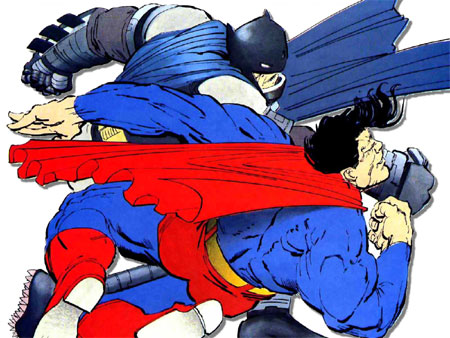
It's no secret that Superman can take most anything thrown at him, be it missiles, super strong opponents, or even meteors. The impact may throw him back a ways, maybe it would even 'hurt' him, but he sustains no real lasting damage (after all, he is The Man of Steel...) unless it is a ridiculous level of damage or the opponent is his match or his better in strength (see Doomsday...). Further, Superman can dish it out as well as he takes a hit. He has shifted tectonic plates, moved the moon, and punched 'reality' so hard that it changed (ok, that was Superboy Prime, but the principle is still sound [and it's ridiculous...]...). It's likely that Superman could honestly solve a majority of the world’s problems by a mere application of force, but he doesn't because of his upstanding, 1950's morality. This level of power also means it is nigh-pointless to have him stopping everyday crime. No one would commit petty crimes with a Superman around (that's for another post altogether...). However, this amount of power and toughness comes into question when we bring in Kryptonian or Kryptonian-esque beings on par (power-wise...) with the Big Blue Boy Scout...

To set the stage, let's say we take a body builder and have him punch a dude who is not a body builder. The guy who got punch will fly back farther than if he had also been a body builder. It's an application of resistance and force; pure physics if you will. Now, let's bring in Superman and an average, comparable Kryptonian (Zod is good...) or Captain Marvel (Shazam for those of you who need clarification...). If a Kryptonian punches something (or somone...) that is not supernaturally tough, the target will go flying. But, using the body builder analogy, Superman should react to a Kryptonian/Shazam punch as if he were a normal guy getting hit by a normal guy. Because of The Man of Steel's inherent toughness, the reaction of his getting sent through the air/through walls/etc. should not occur...

There is a hidden statement when we see Superman take a punch in such a way (and it may be a trifle...). When he gets hit by such a being/force/what have you, not only does his inherent invulnerability become negated, the force of the blow overrides his ability to fly as well. Superman has been shown to be able to turn on a dime and have fine control of his ability to fly, but when he gets hit by such a force, this ability becomes lost until he lands. Afterwards, his flight returns as normal. Again, I realize this is for effect alone and makes combat with Superman better, but by having the Man of Steel react in such a ways makes a statement that has never been explained completely enough for my tastes...

In specialized instances (being surprised, getting hit with a large object with Kryptonian force, etc...) though, I can understand seeing Superman sailing through the air or getting beaten down. It would be similar if someone got sucker punch or knocked a guy out with one punch. And I also understand the need to use such effects in comic books; seeing Superman smashing and getting smashed by a powerful opponent leads to good combat panels and makes a comic that much more exciting. I get it. It would not nearly be as much fun if Superman got punched by Zod and he reacted as if I got punched by, let's say Brian. Not that exciting, really. Now, my knowledge of physics is limited so the original analogy may be flawed due to lack of science know how. However, this is how the subject of invulnerability vs. super strength (with a dash of flight...) is being handled in a not quite believable manner. Prove me wrong, folks...

Thursday, January 20, 2011

The Hood vs The Cowl...

Comics today, but specifically the moving pictures variety. I had the opportunity to watch Batman: Under the Red Hood recently and I was very pleasantly surprised. Not that I actually had a much of an opinion one way or another (I have read the comic version already...), but I had been putting it off because I hadn't really heard much of anything about it at all. I am very glad I gave it a chance and here's hoping you will too...

A little back story: Semi-way back in comic book history, Dick Grayson retired as Robin to become Nightwing and a contender in his own right (a very acceptable and logical character move...), but Batman ended up needing a Robin to back him up. Enter Jason Todd: a spunky kid from the streets Batman took in to prevent him from entering a life of crime. However, it is shown very early on that, since Jason grew up hard on the streets, even at his young age, he did not have the remorseful drive that Grayson or Wayne has. He is far more reckless and got into more trouble than he solved. Flashforward many issues: The Joker kidnaps Jason in a building a beats him nearly to death with a crowbar (very brutal even by most Joker standards...), then leaves him to die in a warehouse that is about to explode. Here's the tricky part: the public voted on whether Jason Todd was to live or die (he was never as popular as the original Robin...). The public voted death, so the second Robin died in an exploding warehouse; just another ghost to follow Batman around...

SPOILERSSPOILERSSPOILERSSPOILERSSPOILERSSPOILERSSPOILERSSPOILERSSPOILERSSPOILERS

Flashforward again: This time, we are very near the present and within the confines of the 'Red Hood' story. A new vigilante enters the scene, calling himself the Red Hood (side note: that was also the first 'moniker' of the Joker...). He runs amok within Gotham's criminal underbelly, but kills the bad guys rather than helping the police lock them up. Batman (with Nightwing in tow...) scour the city in search of this deadly hoodlum. Meanwhile, he kidnaps the Joker and severely beats him with a crowbar (Symbolism, thy name is...) but doesn't kill him. Chases upon chases abound when finally Batman has the Red Hood cornered. We then see who the Red Hood really is: a resurrected Jason Todd (a cosmic calamity brought him back; i.e. Superboy punched the multiverse [ugh...]...). The final showdown happens with Jason giving Batman the choice of either shooting the Joker or shooting his former (dead...) partner to save the Joker. Batman gets out of it, everybody lives, and the bad guys escape. Hey, it's a comic book...

As far as the movie is concerned, it actually a very, very faithful adaptation of the story. The violence level is about on par (some toning down is expected...), even if a lot of it is off screen. It isn't implied that Joker beats Jason with a crowbar; we here sound effects and see shadows of the act as well as more blood than usual. Similarly, one of the cyber-bad guys head explodes and another thug gets immolated on screen. A serious cartoon for a serious audience. The action is well paced and I would imagine it is more of an exciting surprise if you don't know Red Hood's secret (though the toon is self contained, rather than a decade’s long waiting period like in the books...). The voices are also a very solid addition, though I still wanted Kevin Conroy as the Batman. John DiMaggio did a really good job, even if I could tell he was kind of channeling Mark Hamill (check the laugh...) as the Joker. Even the comically frustrated Black Mask worked for me...

Even if you have no feelings toward the Jason Todd character or have little knowledge of who he is, the story itself should be compelling to most who want a little twist into the Batman mythos. Even Batman, who is often the most human of supers, can't seem to die. But to have an actual, on-screen death affects him directly and impacts him in a lasting, meaningful way (like his parents, but much more 'in your face'...), makes the character seem more fallible. And this is important to the continued intrigue of the character. He's not Superman who can shrug off everything and save the day. At the end of the night, Batman is still a man, and it's one of the reasons we dig him so much...

Grade: A+ and the wish that more animated comic book experiences were like this one...

Friday, January 14, 2011

In brightest day\In blackest night...

The hobby of comic book collecting has been quite the passion of mine for many years now. In fact, I have deep, close friendships that haven't lasted as long as my love for comic books (scary...). The art, the stories, the characters, all of it; I can't get enough of the good stuff. In amongst my collection is an unremarkable issue of Tales of the Green Lantern Corps. It is not a number one issue, there was no new or breakthrough characters introduced (at least not for roughly two decades...); it's just a standard 80's comic and it's one of my most cherished. I've had it forever and it shows. Let's have a read...

Here we have it; Tales of the Green Lantern Corps No. 3 for a mere 50 cents 25 years (or so...) ago. Long before Paralax Hal Jordan, decades before Spectre Hal Jordan, we just had plain old GL Hal Jordan, an everyman leader of the GL Corps. He's a brave warrior who wants nothing more than to serve like the rest of the Corps (not original, but we buy it...). This was back when Hal walked the line between badass space warrior and silly hero who creates boxing gloves with his power ring. In this particular issue, there is definitely more of the badass Hal going on. We start with part of the Corps returning to Oa and finding the other half of the Corps recently trounced by an evil Gaurdian of the Universe and an army of pseudo-undead. After a short convalessence, the remaining Corps members (realizing they have very little of their 24 hour ring charge left...), fly off to fight their enemy head on...

Along with the evil Guardian, Krona, is a personification of death known as Nekron. He wants to enter the world of the living and make it more deathlike, I suppose (also not terribly new, but always a popular villain goal...). He returns the rogue Guardians mortal form to him and, in return, Krona leads the undead army into the land of the living in a bid to take over the universe. Here's the readers digest version (ask me to borrow the issue some time...): the Corps shows up to stop the undead army, some die in combat. Realizing that Nekron has near limitless forces to send out, Hal wants to shut down the portal to Nekron's realm, so the rest of the Corps charge Hal up with extra power and he jets into the dead realm. Instead of just blasting the crap out of Nekron (too easy a jump...), Hal reactivates all dead GLs in Nekron's realm, who distract him while the good Guardians finish shutting the portal. The spirit of Hal's ring's previous owner (wrap your head around that one...) pushes Hal out and the day is won...

This piece of a comic book is great. It's everything I want in most comic books, a clearly defined good and evil, virtuous heroes, dedicated villains, colorful art (a definite influence on my CosMick story...) and a generally happy ending. It's very contained within one or two issues and it doesn't cross over with any other books/characters needlessly. If you ever see my copy of it, the pages have grown slightly yellowed and soft due to years of reading over and over. It's a very solid issue and I never get tired of flipping through it...

Grade: A...