Hitting it early this week with a video game review and an odd little game it is. In the 80's, the video game field was dominated by a few main types of game: You had your action platformers (Super Mario Bros., Mega Man, Castlevania, Metroid, etc...), your top down adventure/puzzle games (Legend of Zelda, Bomberman, Final Fantasy, Fester's Quest, etc...), and your various sports simulators (Pole Position, Tecmo Bowl, Jordan vs. Bird: One on One, Excitebike, etc...). Granted, that is an over simplification of the field, but an appropriate one never the less. However, there were a handful of games to break this mold do something uniquely different (yeah, I said it...). One game in particular is a great love from my childhood (you too, tall guy...) and that game is the simply titled M.U.L.E...
M.U.L.E. is an economic strategy game with cooperative elements. The setting is that the players are settlers (aliens, humans, even robots...) on a distant planet and need to not only make a good settlement for yourself, but also increase the overall productivity and value of the entire colony. The game play goes as follows: you are granted a plot of land to which you will work for a resource of your choice (Mining for Smithore, Crystite for Crystite, Energy for Energy, and Farm for Food...); to do this, you purchase a M.U.L.E. (Multiple Use Labor Element) and outfit said M.U.L.E accordingly and place it in the plot. After this point, you can hunt the mountain wampus (???), assay the land for crystite levels, or go to the pub for gambling (this ends the turn...). The turns are timed so you must be quick to make sure you get everything done you need/want to. After this, the plots' resources are gathered and the players take part in the auction phase. Each resource is bartered for 'cash' from either the store or the players who are in need of a particular resource. Resources can also be bought from the store (if it has any to spare...). Lacking particular resources causes bad things to happen during game play (less time in a turn, higher M.U.L.E. prices, etc...). Finally, the leader board is displayed, showing the ranking order of each of the players. Scores are determined by land amount, total number of resources, and cash level. The turn then starts again. Over the course of the game, players can receive beneficial or detrimental messages that affect everybody or just an individual player (Pirate raid the store, M.U.L.E. goes crazy, solar flares, receive an inheritance, etc...). The total point level at the end of the last round determines how well your colony has done and how often supply ships will return to your colony with supplies...
I first experienced this game in the 90's after moving back to Maryland and befriending my buddy, Brian (that's two shout outs in one post, sir...). His dad had it and it was an excellent breath of fresh air after playing games like Super Mario and Tetris religiously. The strangest part of it, even at the tender age of 8 or 9, I really got into it (as did Brian and his siblings...). We got into this strange habit as the messages at the beginning of the turns scrolled across the screen (with dial-up buffering slowness, it seemed...), we would read the messages like a jerky robot. For some reason, even though there wasn't a lot of hilarity in that, that aspect of the game stuck with me almost more so than any other part of it (only slightly more so than the 'walking in place' glitch during the auction scenes...). I would even speculate that my love for complex and intricate board games can be traced to extensive playing of M.U.L.E. It was definitely my gateway game (suck it, Settlers of Catan...)...
The competition in M.U.L.E. is a much more cerebral challenge and requires a different skill set than what is required for platformers or puzzle games. In effect, this game played much more like a board game than a 'standard' video game. The level of resource management and economics within M.U.L.E. had not been seen before in a video game and, while the concept did not take off from here, the ability to effectively create a multiplayer game on the NES and that you could create a dynamic and interesting game in this era video games without the need for enemies flying at you, laser blasts, or power ups. While very easy to get into, M.U.L.E. is a layered, if not complex, 8-bit game whose influence can be seen in other games, video or otherwise down the line. It is the grand daddy to many games of its genre, even if they don't realize it (Will Wright even dedicated The Sims to its creator!)...
A last point: M.U.L.E has proven popular enough (even in cult-ish status...) that individuals have created their own clones of M.U.L.E. to varying success. My personal favorite: Planet M.U.L.E. It has excellent slick graphics and the people who created it really took the time to fine tune the details. I very much enjoy the modern remix of the M.U.L.E theme at the beginning (I do enjoy some techno...) and everything I have played with it, it is a perfect recreation of the mechanics and game play. If you are interested, please click here and give Planet M.U.L.E. a download. You won't be sorry (but your free time will...)...
Showing posts with label old school games. Show all posts
Monday, March 14, 2011
Friday, July 24, 2009
You know what I like...
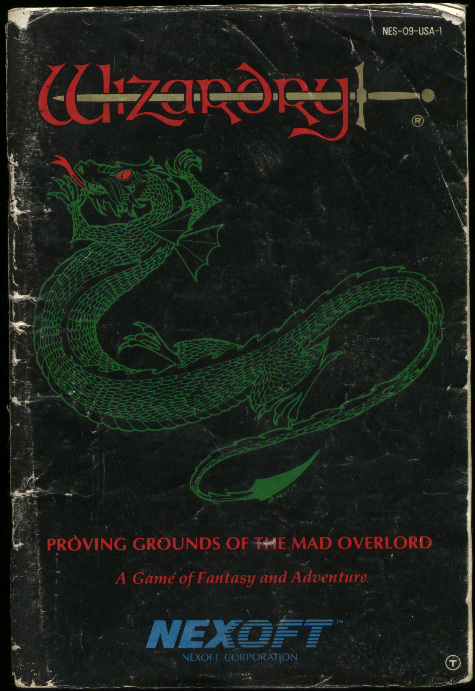
Wizardry: Proving Grounds of the Mad Overlord! Unfortunately, I'm not old school enough to have played it on the oldest of systems (read: pre-NES), so I cut my teeth on it during the dynasty of original NES. On the other side of the coin, I was out of loop for every sequal they ever released after the first Wizardry, so PGMO is all I've got. Regardless, it still to this day holds a special place in my heart, and here's why...

If you've never played Wizardry, here's the reader's digest version: Create a party of adventurers, fight through monsters and assorted baddies, get treasure and experience, and you do this long enough to be powerful enough to beat the end boss Werdna, thus saving the kingdom...or whatever. Too long for you? Let's put it into a recognizable phrase: It's a dungeon crawl. Period. Essentially, this game is Dungeons & Dragons for the NES (it even uses Hobbits instead of Halflings, how'd they get around that?)...
It's also one of the first of its kind, making it the granddaddy of several genres. It is a very early RPG (as far as video games are concerned), so it set the stage for games like Final Fantasy years later. It was also unique in that you travel in first-person view. While combat is turn based (much like future RPGs), you open doors, descend/ascend floors, flip switches, etc. in first person, which at the time was unheard. One of the few other games with 3D elements that I know about is super pointless and lame (can we say Fester's Quest?...). Best of all, I was just getting into D&D at the same time, so I could game with my friends (hey Brian) and then if I didn't get enough, I could go home and game some more. Sweet...

As much as I enjoy this title, I have an issue or two. If you ever play this game, be prepared to exercise ALOT of patience. Character creation is a chore in multiple ways, especially if you've gotten to the luxury of point-and-click RPGs on a computer. To maximize a character, you have to slog through the whole creation process over and over and over and...::SPLARG:: Tweaks me out just thinking about it. Once you finally have your party of six (I recommend 2 Samurai, 1 Cleric, I Thief, 1 Mage, and 1 Wizard, you make it into the dungeon. To get anywhere, you need to do some serious leveling up. This means seeing the same baddies over and over, returning to town to heal, rinse and repeat. I can't get through Floor 3 with level 6 characters, so be warned. Also, don't let anyone die. It's expensive if your party makes it back, and if they ALL die, you start all over with a new party. Blech. Now there is an option where you can go down and find your dead team and bring them back to town, but by that point, your new party should be on par with the old. Like I said, blech...
That aside, I highly enjoy PGMO (just before my party dies) and I recommend it, not only to RPG lovers, but also to you nostalgic NES fans. It's unique in that it came out during at era of Mario and Link and Samus and is still very well thought out and fun. The designers took this project seriously and it shows. If you'd like an old(er) school challenge and are a fantasy lover, keep an eye out for a copy of your own or find an online MOD. Imaginations recommended...
If you've never played Wizardry, here's the reader's digest version: Create a party of adventurers, fight through monsters and assorted baddies, get treasure and experience, and you do this long enough to be powerful enough to beat the end boss Werdna, thus saving the kingdom...or whatever. Too long for you? Let's put it into a recognizable phrase: It's a dungeon crawl. Period. Essentially, this game is Dungeons & Dragons for the NES (it even uses Hobbits instead of Halflings, how'd they get around that?)...
It's also one of the first of its kind, making it the granddaddy of several genres. It is a very early RPG (as far as video games are concerned), so it set the stage for games like Final Fantasy years later. It was also unique in that you travel in first-person view. While combat is turn based (much like future RPGs), you open doors, descend/ascend floors, flip switches, etc. in first person, which at the time was unheard. One of the few other games with 3D elements that I know about is super pointless and lame (can we say Fester's Quest?...). Best of all, I was just getting into D&D at the same time, so I could game with my friends (hey Brian) and then if I didn't get enough, I could go home and game some more. Sweet...
As much as I enjoy this title, I have an issue or two. If you ever play this game, be prepared to exercise ALOT of patience. Character creation is a chore in multiple ways, especially if you've gotten to the luxury of point-and-click RPGs on a computer. To maximize a character, you have to slog through the whole creation process over and over and over and...::SPLARG:: Tweaks me out just thinking about it. Once you finally have your party of six (I recommend 2 Samurai, 1 Cleric, I Thief, 1 Mage, and 1 Wizard, you make it into the dungeon. To get anywhere, you need to do some serious leveling up. This means seeing the same baddies over and over, returning to town to heal, rinse and repeat. I can't get through Floor 3 with level 6 characters, so be warned. Also, don't let anyone die. It's expensive if your party makes it back, and if they ALL die, you start all over with a new party. Blech. Now there is an option where you can go down and find your dead team and bring them back to town, but by that point, your new party should be on par with the old. Like I said, blech...
That aside, I highly enjoy PGMO (just before my party dies) and I recommend it, not only to RPG lovers, but also to you nostalgic NES fans. It's unique in that it came out during at era of Mario and Link and Samus and is still very well thought out and fun. The designers took this project seriously and it shows. If you'd like an old(er) school challenge and are a fantasy lover, keep an eye out for a copy of your own or find an online MOD. Imaginations recommended...
Subscribe to:
Comments (Atom)